
E-Government Development Index: Algeria records its highest score since 2022
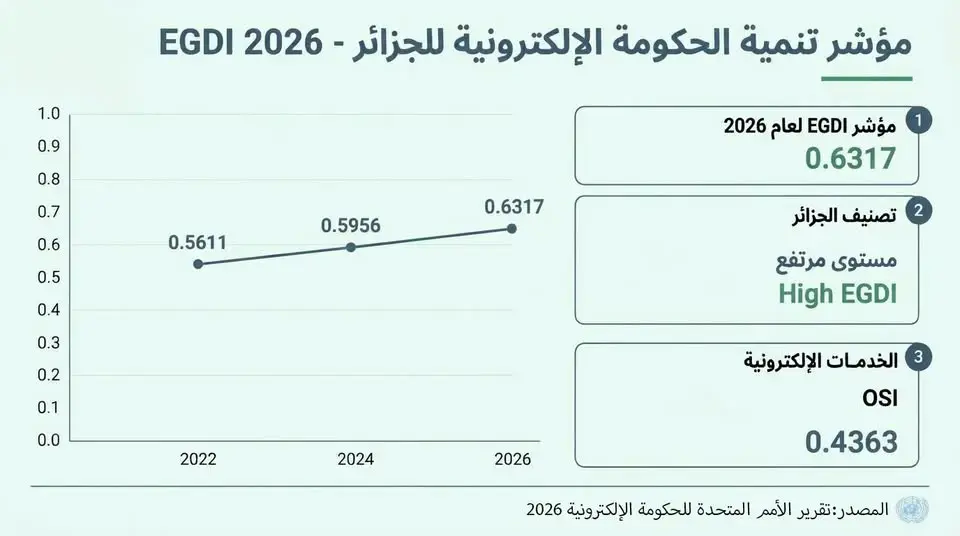
According to the United Nations report for 2026, Algeria has registered its highest score on the E-Government Development Index (EGDI) since 2022, while maintaining its standing in the high EGDI category, a statement from the High Commission for Digitization (HCN) announced on Wednesday. The country attained an EGDI score of 0.6317 in 2026, compared to 0.5956 in 2024 and 0.5611 in 2022, as per the same source. Concurrently, the Online Service Index (OSI) improved from 0.3320 in 2024 to 0.4363 in 2026, reflecting the evolution of government services and efforts to broaden their digitization and accessibility for citizens. This progress stems from ongoing national initiatives to accelerate digital transformation and institutional advancements, notably the establishment of the HCN in September 2023 as the supreme body tasked with steering and coordinating digital transformation in Algeria. These efforts also encompass the development of government information systems, enhanced data interoperability and exchange across sectors, the launch of the National Digital Services Portal (Dzair Digital Services), and the continuous expansion of public services available through this portal in collaboration with various ministerial departments and public institutions. Regarding the Local Online Service Index (LOSI), it stood at 0.1485, highlighting the importance of furthering digital public services at the local level and enhancing their coverage and diversity to meet citizen needs across wilayas and communes. The participation and engagement (PE) component of the OSI recorded a value of 0.1034, following the updated methodology adopted in the 2026 UN report. The High Commission indicated that the upcoming challenge involves transitioning from isolated sectoral digitization approaches to establishing an integrated digital government founded on information system interconnection, data exchange, and procedural complementarity among various ministerial sectors and public institutions. In this context, the High Commission for Digitization plays a central role in guiding and coordinating priority national digital transformation projects and unifying sectoral visions, urging ministerial sectors and public institutions to mobilize efforts and strengthen effective and responsible adherence to this unified national framework. The statement concluded by emphasizing that the challenge is no longer limited to possessing specific digital platforms, but rather ensuring their integration within a unified governmental system via the national portal, thereby enabling citizens to benefit from interconnected services, simplified procedures, reduced document requests, and a tangible impact of digital transformation on their daily lives through smoother public services.